THE BIG QUESTIONS
What will give me purpose after I retire?
Retirement can give you something you've spent decades wishing for: more time. But time on its own doesn't create a fulfilling retirement. The bigger question is what will replace the structure, relationships, challenge and sense of usefulness that work may have quietly provided.
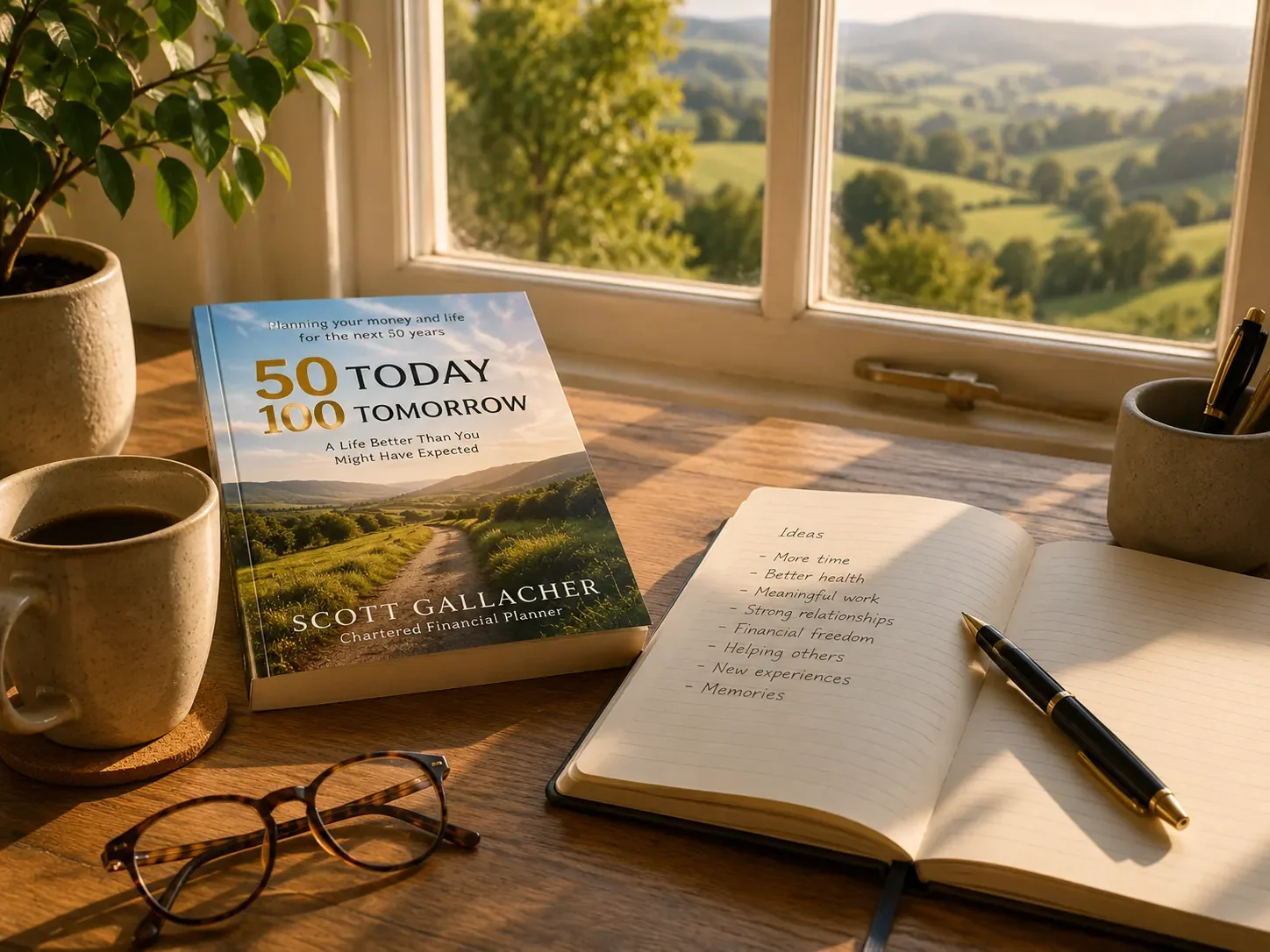
By Scott Gallacher · Chartered Financial Planner · Author of 50 Today 100 Tomorrow
Retirement can give you something you've spent decades wishing for.
An almost empty diary.
No Monday morning meeting. No commute. No emails waiting for an answer. No annual targets. No need to negotiate a fortnight away with anybody.
Initially, that can sound wonderful.
But then comes Tuesday.
And Wednesday.
And, if you're fortunate enough to enjoy a long retirement, perhaps another 1,500 Tuesdays after that.
We spend an enormous amount of time preparing financially for retirement. We build pensions, accumulate investments, pay down mortgages and calculate whether we have enough. Yet comparatively little attention is sometimes given to another question:
What are you actually going to do with all that time?
I don't think the answer is simply to find more hobbies.
The more interesting challenge is understanding what made your life feel worthwhile before retirement — and deciding what will replace the parts of it that disappear when work does.
Work was doing more than paying you
It is easy to think of employment as an exchange: you give up time and expertise and receive money in return.
But work often provides considerably more than an income.
It creates structure. It puts people into your life. It gives you problems to solve, things to learn and reasons to make plans. It can provide status, identity, achievement and the feeling that somebody needs what you can contribute.
You may not particularly enjoy every one of those things. You may actively dislike some of them.
But remove them all at once, and their value can become more obvious.
This is one reason I think retirement is a much bigger life transition than simply changing where your income comes from.
Your pension can replace your salary. It can't automatically replace everything else your job was doing for you.
Busy isn't necessarily the same as purposeful
Many retired people I know are extraordinarily busy.
In fact, I sometimes joke that retired clients can be harder to arrange meetings with than people who are working. Their diaries are full of golf, grandchildren, holidays, volunteering, lunches, clubs, hobbies, family responsibilities and countless other commitments.
That can be a very good sign.
But there is a distinction worth making between filling time and finding purpose.
You could construct a retirement diary containing something every morning and afternoon and still feel that something was missing. Equally, somebody else might have a relatively quiet week but derive enormous satisfaction from a few things that really matter to them.
Purpose doesn't have to mean being busy.
Nor does it require some grand mission for the second half of your life.
You don't necessarily need to start a charity, write a novel, learn Mandarin or climb Kilimanjaro.
Sometimes purpose is much more ordinary than that.
It might come from helping to look after grandchildren. Being the person who organises something at your golf club. Mentoring someone younger. Caring for a partner. Learning something simply because you're interested in it. Helping a charity with skills acquired over a lifetime. Growing vegetables exceptionally well.
The important distinction isn't between impressive and unimpressive activities.
It's between things that merely occupy time and things that make the time feel worthwhile.
The 21 Boxes
One of my favourite ways of thinking about this in 50 Today 100 Tomorrow is something I call the 21 Boxes.
The basic idea is very simple.
Think about an ordinary week as seven mornings, seven afternoons and seven evenings.
That's 21 boxes.
While you're working, a remarkable number of them are already spoken for. Work occupies most weekday mornings and afternoons, and sometimes quite a few evenings as well. Everything else has to squeeze into what's left.
Retirement changes that.
Suddenly, many of those boxes belong to you again.
At first, that freedom can be exhilarating. But it also exposes a question that a working life may have allowed you to avoid:
What deserves to go in them?
The important word is deserves.
The objective isn't to create another timetable and frantically fill every blank space. One of the great privileges of retirement should surely be having some empty boxes — time to read the newspaper, go for a walk, sit in the garden or decide at lunchtime what you feel like doing that afternoon.
The idea simply makes retirement more tangible.
“I'm going to travel more” sounds like a retirement plan.
But even several wonderful holidays might account for only a few weeks of the year.
What does an ordinary Tuesday look like?
That is often the more revealing question.
What will you miss without realising it?
Before deciding what you want to add to retirement, it may be useful to consider what work is currently giving you.
Not what you think you should miss.
What would you actually miss?
Relationships: For one person it might be the people. Their closest friendships may have developed through work, and simply being around colleagues provides social contact they rarely think about.
Challenge: For somebody else it might be challenge. They enjoy solving difficult problems, making decisions or mastering something new.
Responsibility: Others might miss responsibility. Being the person somebody calls when something needs sorting out can be frustrating while you're working and strangely satisfying once nobody needs to call.
Identity: And for some, the biggest loss may be identity. Ask someone what they do and they'll often tell you their occupation. After 30 or 40 years, the distinction between what I do and who I am can become surprisingly blurred.
None of this is an argument for continuing to work forever.
It is an argument for recognising what work currently provides before removing it.
Once you know what you might miss, you can start looking for other places to find it.
Purpose doesn't have a retirement age
There is a slightly depressing assumption hidden in some traditional images of retirement: you spend the first part of life achieving things, and then you stop.
I don't think life needs to work like that.
Someone who enjoyed learning at 55 doesn't suddenly lose their curiosity at 65. Someone who enjoyed solving problems doesn't necessarily want a life without challenge. Someone who spent decades helping clients, patients, pupils, colleagues or employees may still want to feel useful when they're no longer paid to do it.
The retirement expert and author Mitch Anthony has identified what he calls the Five C's of a successful retirement: Connectivity, Challenge, Curiosity, Creativity and Charity. I explore these in 50 Today 100 Tomorrow because they provide a useful way of thinking about some of the things work may have been giving us without our realising it.
You don't necessarily need all of them in equal measure.
The more useful question is what work currently gives you that you would miss — and where you might find it once work is no longer there.
What matters is less what you choose than what the activity gives back to you:
Does it connect you to other people?
Does it make you think?
Does it give you something to look forward to?
Does anybody benefit from your involvement?
Do you occasionally finish the day with the satisfying feeling that you've done something worthwhile?
Those strike me as better questions than whether your retirement sounds impressive to somebody else.
You don't need one great passion
I would also be wary of the advice that everybody needs to “find their passion” before retiring.
For some people, that might be exactly right. For others, it creates another unnecessary retirement target.
A good life doesn't necessarily require one overriding purpose. It can be assembled from several smaller sources of meaning: relationships, interests, contribution, learning, exercise, family and simply enjoying greater freedom.
Your sense of purpose may also change.
At 62 you might want challenge and adventure. At 72, grandchildren or community involvement might occupy more of your attention. At 82, relationships and independence may matter more than achievement.
A retirement that could last 30 or 40 years doesn't need a single purpose capable of surviving unchanged throughout it.
Perhaps what matters more is remaining engaged enough with life to keep finding new ones.
Don't wait until the leaving party
There is a practical implication to all this.
If retirement is approaching, don't wait until you've finished work to discover whether the life you've imagined actually suits you.
Experiment beforehand.
If you think volunteering might interest you, try it. If you've always wanted to learn something, start now. If you imagine playing golf three times a week, see whether you actually enjoy playing that often.
Pay attention to what happens during longer holidays or periods away from work. After the initial pleasure of not working has worn off, what do you naturally find yourself doing?
Perhaps most importantly, invest in relationships outside work.
Work can create an extraordinarily convenient social network because people are simply there. Retirement removes that convenience. Maintaining friendships, joining organisations and becoming part of communities takes more deliberate effort.
None of this means constructing your retirement decades in advance.
It simply means starting to build a life that doesn't depend entirely upon work before work disappears from it.
Money can fund freedom. It can't tell you what to do with it
This is where purpose belongs within financial planning.
Not because a financial planner can tell you what should give your life meaning. I certainly can't.
But there is little point spending decades building financial independence without thinking about what you want that independence to make possible.
Money can make retirement possible.
It can pay for travel, hobbies and experiences. It can allow you to help family, support causes you care about or continue doing work because you choose to rather than because you need the salary.
But money can't decide which of those things will matter to you.
That part of the retirement plan has to come from somewhere else.
So, what will give me purpose after I retire?
Probably not one thing.
And certainly not something I, your pension provider or a retirement calculator can prescribe for you.
Start instead by looking at what makes your life meaningful now.
Which parts of work would you genuinely miss? Which people matter to you? What still challenges or interests you? Where do you feel useful? What have you repeatedly postponed because work consumed the time?
Then consider what an ordinary week might look like when much more of that time becomes yours.
You don't need all 21 boxes filled.
In fact, filling every one of them rather defeats part of the point of retirement.
Leave room for spontaneity. Leave room for doing very little. Leave room for changing your mind.
But make sure enough of those boxes contain people, interests, challenges and contributions that matter to you.
Because retirement doesn't automatically give you purpose.
It gives you time.
The opportunity is deciding what deserves to fill it.
Keep exploring
Next Big Question
Should I retire early or keep working? →
Retirement doesn't have to be an all-or-nothing decision. Explore the trade-off between more money, more time and the role work plays in your life.
From the Journal
The Tuesday Morning Test →
Holidays and hobbies are easy to imagine. But what will an ordinary Tuesday morning actually look like once work no longer fills your week?
From The Collection
Retirement Readiness Scorecard →
Explore the financial and practical questions worth considering before you retire — including longevity, changing spending and the unexpected.
More Big Questions
Explore all The Big Questions →
Explore the ideas further
50 Today 100 Tomorrow explores how money, time, health, family and purpose fit together when planning for what could be a very long retirement.