THE BIG QUESTIONS
Should I retire early or keep working?
If you can afford to retire, deciding whether you should is about more than money. Working longer can provide greater financial security, purpose and stimulation. Retiring earlier gives you something equally valuable: more time while you are hopefully healthy enough to enjoy it. For many people, the best answer may lie somewhere between the two.
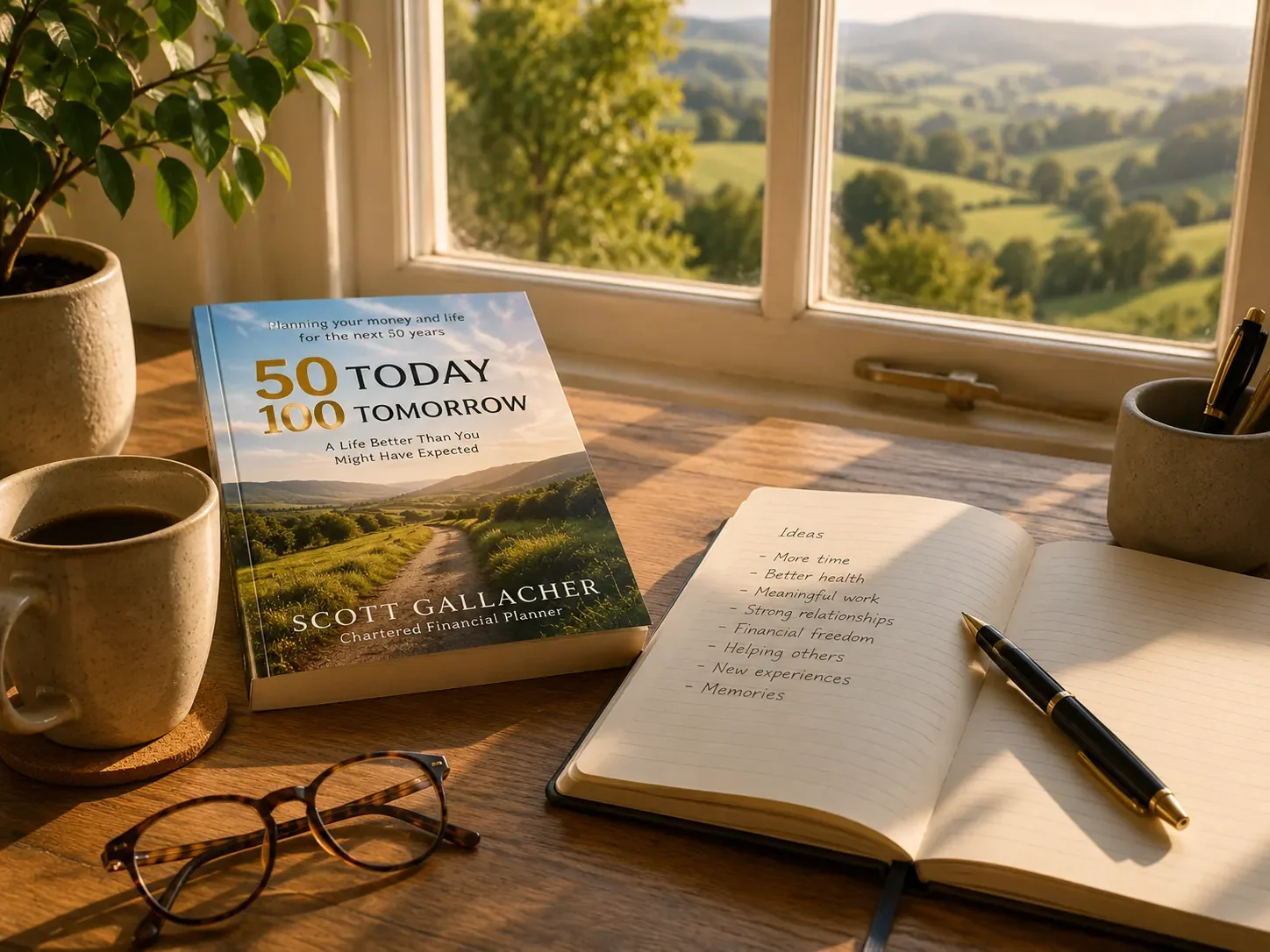
By Scott Gallacher · Chartered Financial Planner · Author of 50 Today 100 Tomorrow
I spend a considerable amount of my working life helping other people decide whether they can afford to retire. You might therefore assume that, after nearly 30 years as a financial planner, I would find the same decision rather easy for myself.
I don't.
There will probably come a point when my partner and I have enough money for me to stop working, but that doesn't automatically mean retirement will be the right decision. Continuing to work could provide greater financial security and allow me to create more wealth for my children and perhaps grandchildren who don't even exist yet. I also enjoy much of what I do. Advising clients, running a business, solving problems and writing all provide purpose and intellectual stimulation.
Against that is something rather harder to put on a spreadsheet. Every additional year I work is one less year when I have complete freedom over my time.
That is why I think “When can I afford to retire?” is only the beginning. Once retirement becomes financially possible, a much more interesting question appears: what is another year of work actually worth to you?
What does another year of work actually buy you?
Working longer can have a remarkably powerful effect on retirement finances. You earn for another year rather than drawing on your savings. You may make another year's pension contributions, your investments have another year to grow and your eventual retirement is one year shorter.
For someone whose finances are marginal, those benefits can be enormously important. Another year or two of work might turn an uncomfortable retirement plan into a resilient one. But the calculation changes once you are already financially independent.
Suppose another year of work would leave you £50,000 better off. That sounds attractive. But if you already have sufficient resources to fund the life you want, the decision isn't simply whether another £50,000 would be nice to have. It is whether £50,000 is worth another year of your working life.
For some people, the answer will emphatically be yes. For others, it won't.
The price of retiring early
There is a danger of romanticising early retirement. Stopping work earlier usually has a financial cost: you give up earnings, perhaps employer pension contributions and potentially years of further investment growth. Your accumulated wealth also has to support you for longer.
If retiring at 60 rather than 65 means funding five additional years without employment income, the difference can be substantial. That is why early retirement shouldn't begin with a motivational slogan about escaping work. It should begin with understanding your financial reality.
What does your life cost? What income will you have? What assets are available? What happens if investment returns disappoint or inflation is higher than expected? Could the plan cope if you or your partner lived considerably longer than expected?
Only once those questions have been tested does early retirement become a genuine choice rather than a financial gamble.
Working longer has a cost too
Financial planning is naturally good at calculating the cost of retiring early. We are less good at calculating the cost of retiring late.
Suppose you could retire comfortably at 60 but decide to work until 65 because another five years will make your finances even stronger. At 65, you will almost certainly have more money. But you won't be 60 any more.
The difficulty is that not all years are interchangeable. Five additional years of retirement between 60 and 65 aren't necessarily equivalent to five additional years between 85 and 90. There may be things you can comfortably do at 62 that become more difficult at 82: long-haul travel, physically demanding hobbies, looking after grandchildren or simply having the energy to pack more into a day.
Nobody knows when health or circumstances will change, and that uncertainty is precisely why those earlier years have value. When you postpone spending £20,000, the money is still there next year, perhaps with some investment growth. When you postpone an experience that depends upon health, energy or the presence of someone you care about, the opportunity itself may not wait.
This doesn't make working until 65 a mistake. You may love your job and those five years might be immensely rewarding. The point is simply that both decisions have a cost: retiring early costs money; working longer costs time.
A good retirement decision needs to put both sides of that equation on the table.
What are you retiring to?
There is an equally important argument against retiring simply because the spreadsheet says you can. Work provides more than a salary. It can provide routine, friendships, status, identity, challenge and a reason to get out of bed in the morning. For someone who has spent decades building a career or business, removing all of that on a Friday afternoon and calling yourself “retired” on Monday morning can be a much bigger transition than expected.
It is easy to imagine retirement through its highlights: holidays, restaurants, golf, time with grandchildren and the freedom to wake up without an alarm. The harder question is what an ordinary Tuesday morning looks like six months later. Who will you see? What will challenge you? What will give structure to the week? What will make you feel useful?
In 50 Today 100 Tomorrow, I explore a simple exercise for thinking about how an ordinary week might actually look once work stops filling so much of it. The purpose isn't to create an impossibly busy retirement diary. It's to recognise how much structure work currently provides — often without us noticing.
Holidays and golf may be part of the answer. I certainly hope golf will be part of mine. But even things we love can feel different when they move from being a welcome break from work to becoming the default way we fill our time.
Being financially ready for retirement and having a life you genuinely want to retire to are not necessarily the same thing.
The accidental return to work
I've seen an interesting version of this during my years advising people approaching retirement. Someone retires, only for their former employer to ask whether they could help out for a few weeks. Perhaps they agree to come in two or three days a week. It gives them some income, keeps them involved and makes the transition less abrupt.
Then I see them at their next review and somehow they're virtually working full-time again.
I don't necessarily think that's a bad outcome. Sometimes it tells us that work was providing more than the person realised. They missed the challenge, the people or simply the feeling of being useful. For some people, gradually letting go of work may also be much easier than stopping abruptly.
The danger isn't returning to work. It is drifting back into the old working life without ever consciously deciding that this is how you want to spend your time.
And that points towards what I think is a more interesting alternative to the traditional retirement decision.
Vacation and Vocation
In 50 Today 100 Tomorrow, I describe it as Vacation and Vocation.
We tend to frame retirement as a binary decision. You are either working or retired. But once you have achieved a degree of financial independence, that distinction can become unnecessarily restrictive.
Perhaps you enjoy your work but would rather do three days instead of five. Perhaps you want to advise or consult without managing people. A business owner might step away from day-to-day management while retaining an interest in the company. Someone else might mentor, take a board position, start a small venture or continue doing only the parts of their career they genuinely enjoy.
The objective doesn't necessarily have to be stopping work.
It can be gaining control over your time.
There can be financial advantages too. If part-time earnings cover a meaningful proportion of your expenditure, your investments may remain untouched for longer and the pressure on the retirement plan can fall considerably. But the bigger benefit may be personal: retaining some of the challenge, social connection and purpose that work provides while creating considerably more room for everything else.
For someone who dislikes their work, full retirement may still be the obvious answer. For someone who enjoys it, the better question may not be “When should I stop working?” but “How much work do I still want in my life?”
That, to me, is one of the great opportunities created by financial independence. Money doesn't simply give you the option to stop working. It can give you the power to change the terms on which you work.
Be careful about waiting for certainty
Of course, even when retirement is affordable, stopping or reducing work can feel uncomfortable. Another year's salary is known; investment markets are not. Work is familiar; retirement isn't. So it is tempting to wait until the decision feels completely safe.
The problem is that complete certainty is unlikely to arrive. There will always be another risk you could protect against, another market fall that might happen, another future expense you haven't anticipated and another amount you could accumulate.
Financial planning can reduce uncertainty. It cannot eliminate it.
Eventually, if your plan is robust and retirement is genuinely affordable, continuing to work becomes less about financial necessity and more about what you choose to do with your time. Recognising when you have crossed that line matters, because otherwise “one more year” can rather easily become another one after that.
What if I enjoy working?
Then there is no particular reason why you should stop.
There is no prize for retiring early. If your work gives you purpose, enjoyment, friendships and stimulation, and you still have enough freedom to do the other things that matter to you, continuing may be exactly the right decision.
But enjoying work doesn't mean you have to continue doing it in exactly the same way. Perhaps the answer is fewer days, longer holidays, more time on the golf course, greater freedom to choose which work you take on or simply becoming more protective of your diary.
For me, that middle ground is increasingly interesting. Rather than viewing work and retirement as two completely separate chapters, perhaps financial independence allows us to begin enjoying more of the fruits of our labour while we are still working.
That isn't necessarily retirement. It is redesigning work around your life rather than continuing to design your life around work.
So, should I retire early or keep working?
Start with the financial question. If retiring early would leave your long-term position uncomfortably exposed, working longer may be the sensible choice.
But once the numbers say you genuinely have a choice, the decision stops being purely financial. You need to think about what work gives you as well as what it takes from you, what another year of earnings would actually change, and what you would do with the additional freedom if you had it.
Nor do you necessarily have to choose between maximum wealth and complete retirement. For many people, the answer may lie somewhere in between: continuing to contribute, earn and enjoy the parts of work that matter while becoming much more deliberate about protecting time for everything else.
Retirement then stops being a date on which work suddenly ends. It becomes a gradual shift in the balance between money and time, vocation and vacation, accumulation and freedom.
There is no universally correct age to retire. The right point is personal, and it may change as your finances, health and attitude towards work change.
But once you have enough money to choose, perhaps the most useful question is no longer:
“How much more could I have if I kept working?”
It is:
“What could I do with the time if I didn't?”
Keep exploring
Next Big Question
How do I know when I have enough? →
Because deciding when to retire starts with understanding when continued accumulation is no longer necessary.
From the Journal
The Cost of Overshooting →
What happens when the pursuit of greater financial security starts costing you something you can't replace: time?
From The Collection
Retirement Readiness Scorecard →
Explore the financial and practical questions worth considering before you retire — including longevity, changing spending and the unexpected.
More Big Questions
Explore all The Big Questions →
Explore the ideas further
50 Today 100 Tomorrow explores how money, time, health, family and purpose fit together when planning for what could be a very long retirement.