
The Lever Most Successful Savers Struggle to Pull
The habits that helped you build wealth may not be the habits that help you enjoy it
After nearly thirty years as a financial planner, I’ve noticed something surprising about many successful savers. Their hardest habit to break isn’t overspending. It’s underspending. Many successful people find it far easier to save money than to spend it.
I think of it as us all having a giant lever.
On one side is SAVE AND INVEST. On the other is SPEND AND ENJOY.
For much of our working lives, the lever needs to be firmly pressed towards Save and Invest. We earn, contribute to pensions, build investments, reduce the mortgage, and keep something back for an emergency. We resist the temptation to spend everything today.
Those habits matter. For many people, they are precisely how financial independence is created.
But eventually, the purpose of all that saving and investing must be considered. At some point, the lever may need to move.
And that is where many successful savers struggle.
Good financial habits are hard to unlearn
The people who seek financial planning advice are rarely reckless spenders. They are usually people who have worked hard, lived within their means, and accumulated wealth gradually over many years. They are successful precisely because they developed strong financial habits.
They learned to delay gratification. They understood that money spent today cannot also be invested for tomorrow. They worried about redundancy, retirement, and unexpected bills. Even as their income increased, they remained careful.
After thirty or forty years, that behaviour becomes more than a financial strategy—it becomes part of who they are. So when retirement approaches and the numbers suggest they can afford to spend more, they do not suddenly become comfortable doing so.
A spreadsheet might say yes. Every instinct you’ve developed over thirty years still says no.
"I spend half my day telling clients to spend more"
I often joke that I spend half my working day nagging clients to spend more. There is more truth in that joke than many people realise.
I have met people with substantial pensions and investments who will happily spend hours searching for a slightly cheaper flight. They postpone replacing an unreliable car. They continue taking the same modest holidays, even when there are other places and experiences they would dearly love to explore.
None of those decisions is necessarily wrong. Frugality can be a virtue, and spending more does not automatically mean living better. The problem arises when being careful becomes automatic.
The holiday they would genuinely love to take remains indefinitely on the wish list. The family celebration gets postponed. The offer to help a child arrives several years later, when it would have made far less difference.
They continue telling themselves they will enjoy the money "one day." But eventually, one day becomes today—and by then, some opportunities may already have passed.
The lever is not an on-off switch
Moving the lever towards Spend and Enjoy does not mean abandoning common sense. It does not require lavish holidays, expensive cars, or spending for the sake of it. Nor does it mean emptying your pension as soon as you retire.
The lever is not an on-off switch; it is a way of thinking about balance.
There will still be bills to pay, emergencies to prepare for, and an unknown number of future years to fund. Later-life care may be needed, markets will have difficult periods, and inflation will gradually increase the cost of living. Your future self still deserves protection—but your present self deserves consideration too.
The objective is not to swing recklessly from lifelong saver to enthusiastic spender. It is to decide whether the balance that served you during the accumulation years remains appropriate for the life you now want to lead.
What was all the saving for?
This is the question that can easily be overlooked. We become very good at measuring how much we have accumulated. Pension statements, investment valuations, and bank balances all provide reassuring evidence of progress. But a larger number is not, by itself, a better life.
Money is a tool. Its value comes from what it allows you to do.
That might mean retiring earlier, reducing your hours, or leaving a stressful role. It could mean travelling, pursuing an interest, supporting someone you love, or simply enjoying an ordinary Tuesday without worrying about the cost.
Not every pound needs to produce a memorable experience. Sometimes money buys nothing more dramatic than time, comfort, or peace of mind. Those are worthwhile returns too.
Planning can provide permission
For most lifelong savers, the barrier isn't a lack of money—it's a lack of permission.
That is one of the most valuable roles a proper financial plan can play.
It can test the consequences of spending more. It can allow for inflation, poor investment returns, a long life, and unexpected costs. It can show what might happen if you retire earlier, give money away, or take the holiday now rather than in ten years.
No plan can remove every uncertainty. But it can replace a vague fear of running out with a clearer understanding of what is realistically affordable.
Sometimes the answer will be that you should remain cautious. But often, it gives you something equally valuable: permission to enjoy what you have built.
Which way is your lever pointing?
If you’ve spent decades pressing firmly on Save and Invest, shifting that lever will feel uncomfortable. That discomfort isn’t necessarily a sign you’re making a mistake. It may simply be a sign you’re entering a new phase of life—one in which money is no longer only being accumulated for an unspecified future.
Perhaps the question is not simply: How much more can I save?
Perhaps it is also: What am I saving it for?
Good financial planning should help you live well, leave well, and avoid running out of money. All three matter. Because the purpose of a lifetime of sensible financial decisions isn't to die with the largest possible bank balance. It should be to create a life that was made better by having the money in the first place.
This article is adapted from my book, 50 Today 100 Tomorrow: Planning Your Money and Life for the Next 50 Years. If you're ready to align your finances with the life you actually want to live, you can find the book here.
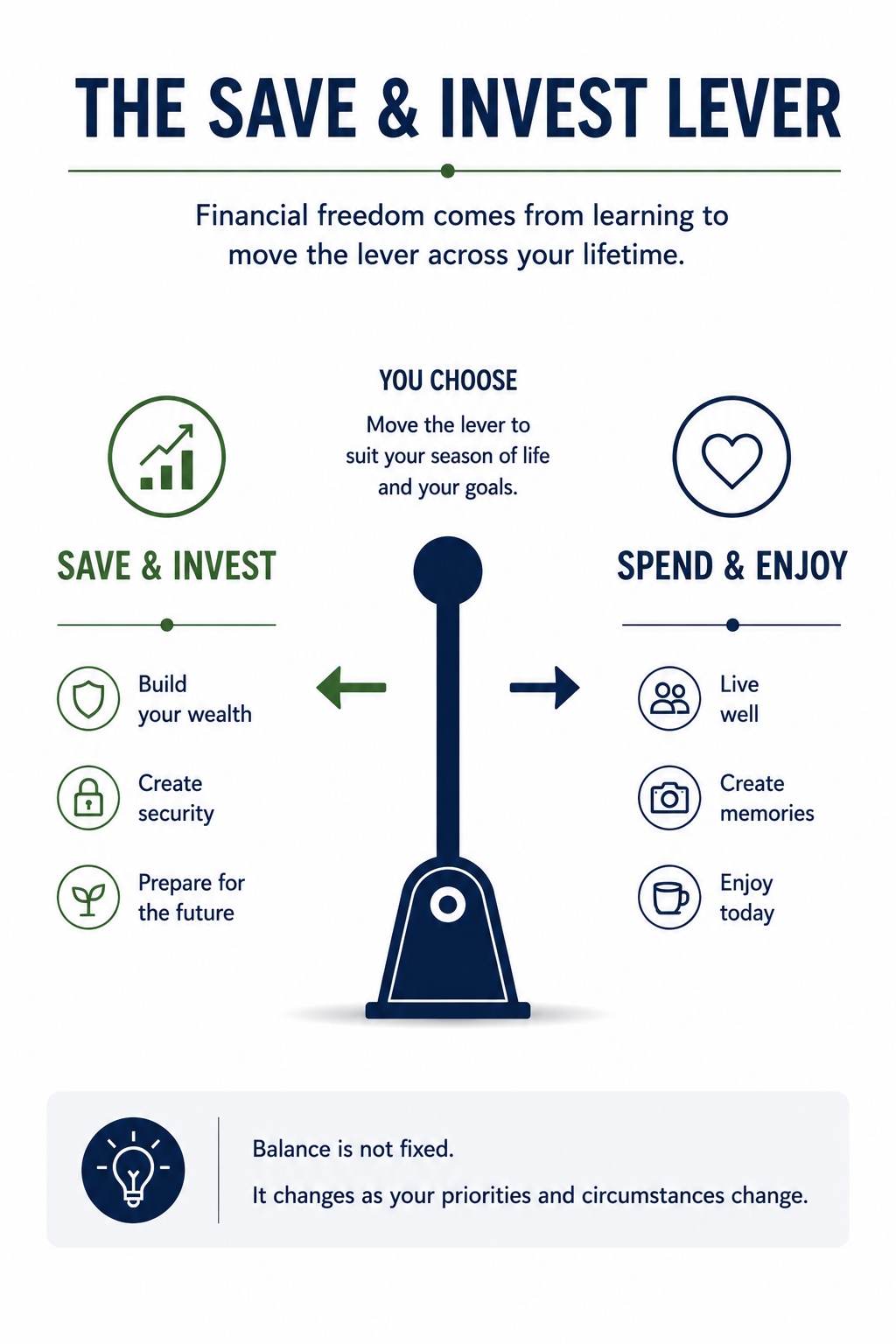
The 100 Tomorrow lever illustrates one of the central ideas of the philosophy: throughout life we continually balance saving and investing for the future against spending and enjoying life today. As circumstances change, the balance may need to shift.
Enjoyed this article?
Join Tomorrow's Notes for one thoughtful email every Friday with ideas about money, time and living well.