THE COLLECTION · VOLUME 01
The 21 Boxes Framework
What will you do with an ordinary week when work no longer fills it?
Retirement can give you something you've spent decades wishing for: more time.
But more time raises a surprisingly difficult question: what will you actually do with it?
Holidays are easy to imagine. So are long lunches, golf, gardening, travelling and spending more time with family.
But retirement isn't made up only of holidays and special occasions.
It is also made up of ordinary Monday mornings, Wednesday afternoons and Thursday evenings.
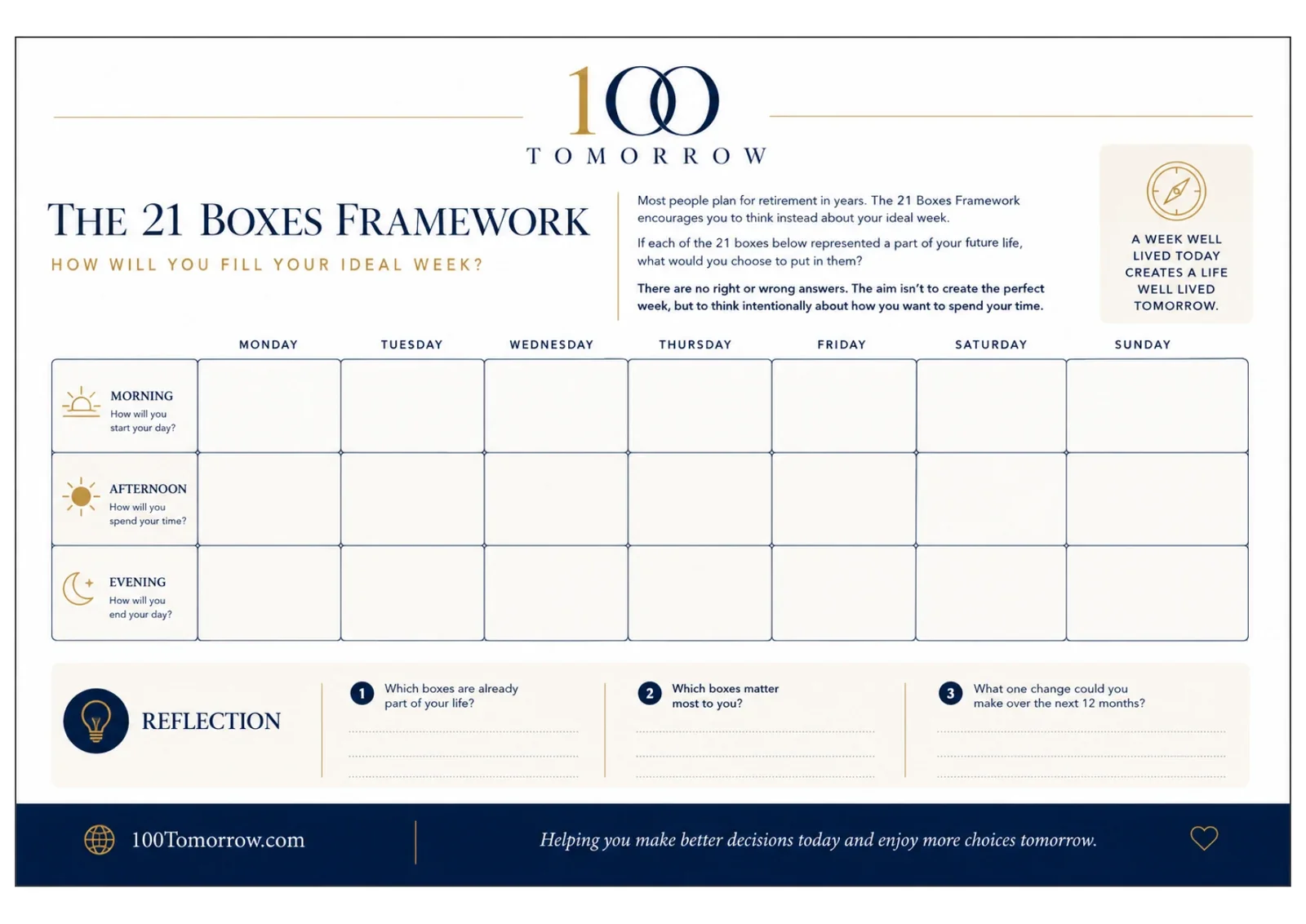
The 21 Boxes is a simple way to picture what an ordinary week after work might actually look like — and to think about what you want to fill it with.
An ordinary week has 21 boxes
Think of your week as:
7 mornings
7 afternoons
7 evenings
That's 21 boxes.
While you're working, many of them are already spoken for.
Monday morning? Work.
Tuesday afternoon? Work.
Thursday morning? Work.
And work can spill into evenings too, whether you're actually working or simply tired after a long day.
Retirement gives many of those boxes back to you. Which sounds wonderful.
But it also creates the question at the heart of this exercise: what deserves to go in them?
Retirement isn't a seven-day weekend
One of the easiest ways to imagine retirement is as an extended holiday. No alarm clock. No commute. No meetings. More golf. More travelling. More time with friends and family.
And for the first few weeks or months, perhaps that's exactly what you want.
But a retirement lasting 20, 30 or even 40 years needs more than an itinerary of holidays.
Work may currently provide things you barely notice: structure, relationships, challenge, responsibility, identity and the feeling that somebody values what you contribute.
When work disappears, some of those things can disappear with it.
The 21 Boxes isn't about replacing work with another impossibly busy timetable. It's about thinking deliberately about the life you're creating in its place.
What might fill your boxes?
There is no correct answer.
Your week might include time with family and friends, exercise, golf, volunteering, learning, hobbies, travel, caring responsibilities, part-time work, community involvement or simply time to yourself.
Some boxes might contain things that challenge you.
Others might connect you with people.
Some might give you a sense of usefulness or achievement.
And some should probably contain very little at all.
An empty box isn't necessarily a problem. After decades of diaries, deadlines and responsibilities, having the freedom to decide what to do with a Wednesday afternoon may be one of retirement's great luxuries.
The aim isn't to fill all 21. It's to make sure that enough of them contain things that make an ordinary week feel worth looking forward to.
The Tuesday Morning Test
Imagine you've been retired for six months.
The leaving celebrations are over. You've had the first holiday. The jobs around the house have been done.
It's an ordinary Tuesday in November. You wake up.
What are you looking forward to today?
That question can tell you considerably more about your retirement plans than a list of countries you intend to visit. Because a good retirement needs to work on ordinary Tuesdays too.
Try the 21 Boxes
Start with an ordinary week. Not your dream week. Not a week on holiday. Not Christmas with the family. Just a normal week six months or a year after you've stopped full-time work.
What might already have a place?
What would you like to do more often?
Who would you like to see?
What would keep you physically active?
What might challenge you intellectually?
Where could you still contribute or feel useful?
And which boxes would you quite happily leave empty?
You don't need to have all the answers. The exercise is designed to make the questions visible.
Click the preview to download the free workbook.
Knowing where you are changes what you can ask
Once you've brought everything together, more interesting questions become possible.
Do I have enough to retire?
How much income will I actually need?
Could I afford to stop working earlier?
Am I holding too much cash — or too little?
Could I afford to spend more?
What happens if I live considerably longer than expected?
The workbook won't answer every one of those questions for you.
But it gives you something much more useful than a guess:
A starting point based on your own financial reality.
Your 21 Boxes will change
The week you want at 60 may not be the week you want at 70. And it almost certainly won't be the week you want at 85.
That's fine.
The 21 Boxes isn't a retirement timetable to follow forever. It's a snapshot.
Come back to it as your health, interests, relationships and circumstances change. You may find some boxes become more important. Others disappear altogether. And something you never imagined doing may eventually occupy several of them.
That's part of the point. A long retirement isn't one life repeated for 30 years. It continues to change.
Ready to explore your 21 Boxes?
Retirement can give you more control over your time than you've probably had since you were young.
The question isn't how to keep yourself permanently busy. It's what you want that freedom to make possible.
The 21 Boxes gives you a simple place to start.
Volume 01 · The 100 Tomorrow Collection
No email address required.
Keep exploring
From The Big Questions
What will give me purpose after I retire? →
Explore what might replace the structure, relationships, challenge and sense of usefulness that work once provided.
From the Journal
The Tuesday Morning Test →
Holidays are easy to imagine. But what will an ordinary Tuesday morning actually look like once work no longer fills your week?
Explore The Collection
See all 100 Tomorrow resources →
Explore The Book
50 Today 100 Tomorrow →